Sound the ALARM: Two recent VRTI team publications
Two new publications authored by VRTI Team members have been recently released.
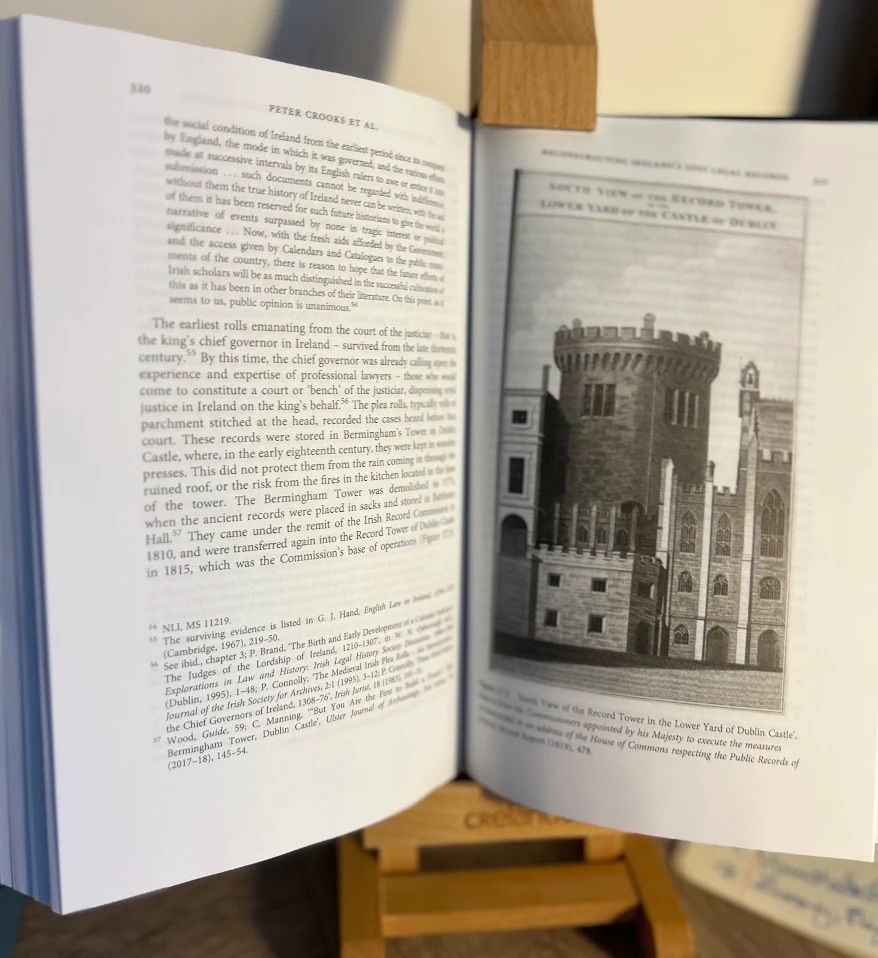
The first, “Courting the Past: Reconstructing Ireland’s Lost Legal Records, circa 1300–1922” appears as a chapter of Law and Constitutional Change, edited by David Capper, Conor McCormick, and Norma Dawson (307–40. Cambridge: Cambridge University Press, 2025).
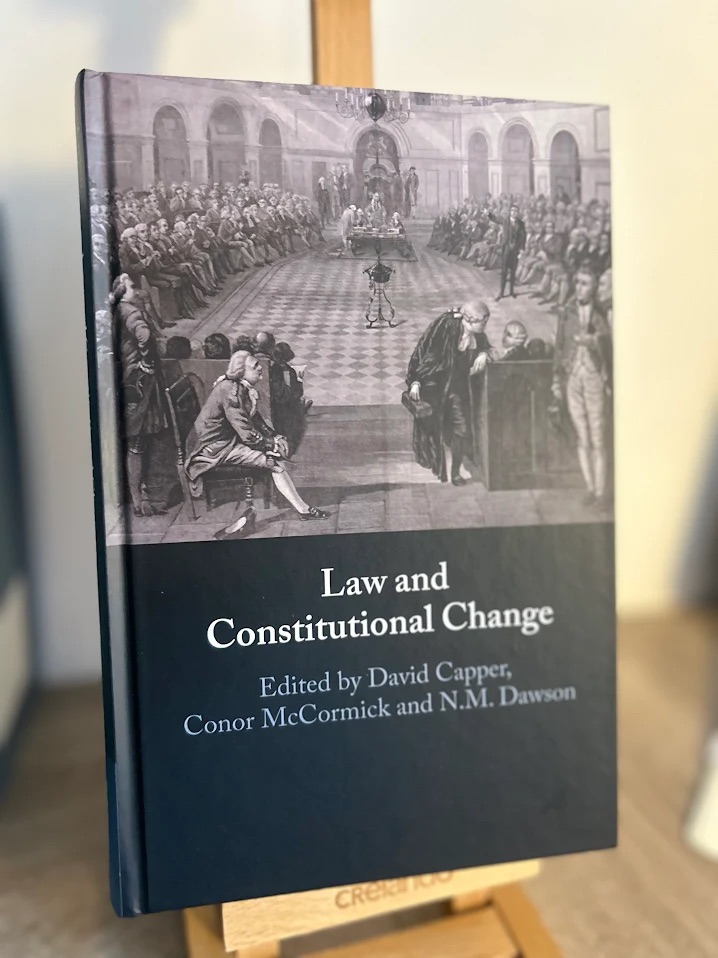
Image courtesy of Peter Crooks.
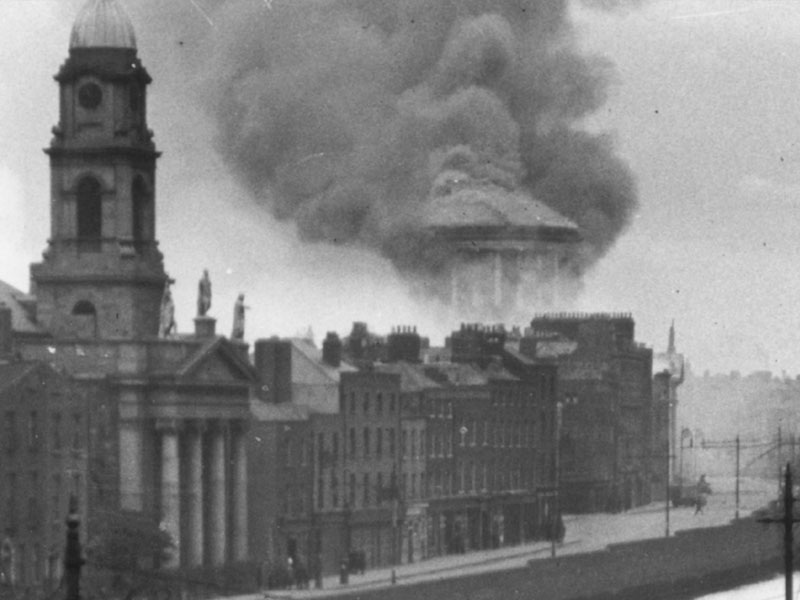
This chapter provides an account of the Public Records Office of Ireland as a legal repository, before its destruction in 1922 as an early ‘casualty’ of the Irish Civil War. It supplies a succinct account of Ireland’s historic courts and their record-keeping, providing an overview of the legal contents of the Public Record Office of Ireland at the moment of its destruction. Using several case studies, the chapter then illustrates the process of archival reconstruction through the use of substitute and replacement sources, spanning the late medieval period up to the end of the nineteenth century. It argues that attempting to reconstruct these lost legal archives constitutes a powerful method of historical reappraisal, revealing how many of Ireland’s historic courts were created, evolved and disappeared.
The second, an article titled “How to Reconstruct a Lost Archive in the Digital Age: The Virtual Record Treasury of Ireland, The Fire of 1922, and the Archival Loss and Recovery Model (ALARM)” was published in the Belgian journal Archives et Bibliothèques de Belgique / Archief- en Bibliotheekwezen in België XCIV (2023), 113-44.
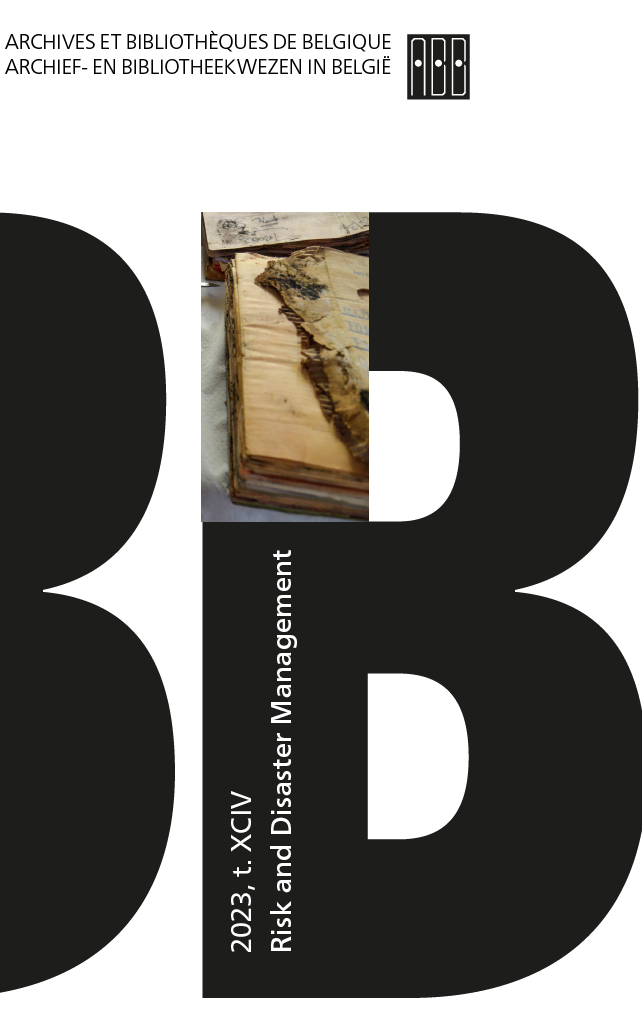
Cover of ABB volume XCIV (2023).
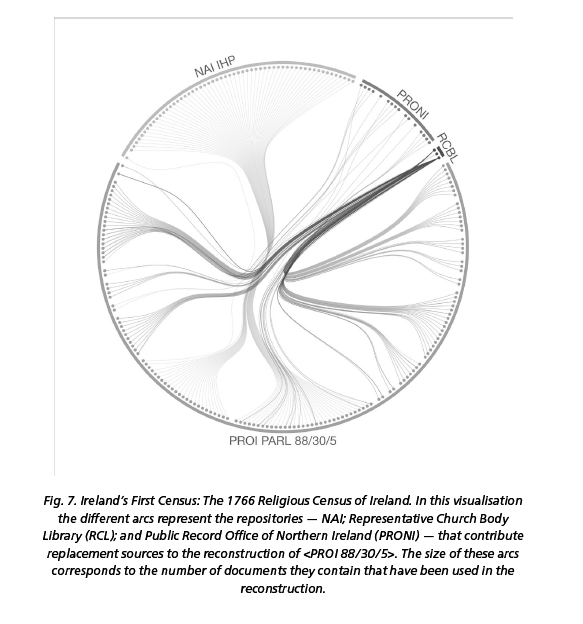
Published alongside pieces on cultural reconstruction in Ukraine and Bosnia, the Archival Loss and Recovery Model (ALARM) described in this article seeks to map out connections across an archival landscape, tracing the links between replacement sources routing them back to the destroyed collections. Sadly, many lost archives are unique and cannot be directly replaced.
Even when a replacement can be identified, it can never fully substitute for lost originals whose interest may have been their physical and material properties as much as their textual content. Replacement sources themselves vary in quality and completeness. ALARM makes a virtue of these limitations. The underlying principle of ALARM is that recovery is always partial, but it is powerfully aggregative. The model lays bare those parts of the lost archive that can never be recovered, and encodes the limitations of replacement sources.
This enables the researcher to form judgements about the fidelity of the available digital surrogates. The accumulation of replacements of all kinds in a hierarchical and interlinked structure creates a powerful resource.
Full bibliographic references to these two pieces can be found on our Publications page.
Date
Thursday, 11 December 2025, 4:02 PM
Author
Jean-Philippe SanGiovanni